SPAIN
Running of the Bulls in Pamplona: What to Expect at San Fermín
•
SHARE:
This post contains affiliate links. If you book through them, I earn a commission at no cost to you. Learn more
While living as a digital nomad in Barcelona, I made the trip north to Pamplona for San Fermín, what most people know as the Running of the Bulls in Pamplona. If you’re planning a Running of the Bulls 2027 trip, it helps to know that the event is much bigger than one chaotic morning. I went expecting two minutes of adrenaline. What I found instead was a nine-day festival that felt much bigger than the run itself.
This is a practical guide for first-timers, especially spectators. I’ll cover how the run works, the best ways to watch it, where to stay, how many nights you need, what it cost me, and what to expect from San Fermín beyond the headline event.
SAN FERMÍN AT A GLANCE
Dates: July 6-14
Bull runs: July 7–14 at 8:00 a.m.
Run duration: 2–3 minutes
Recommended stay: 2–3 nights
Location: Pamplona, Spain
What San Fermín Actually Is
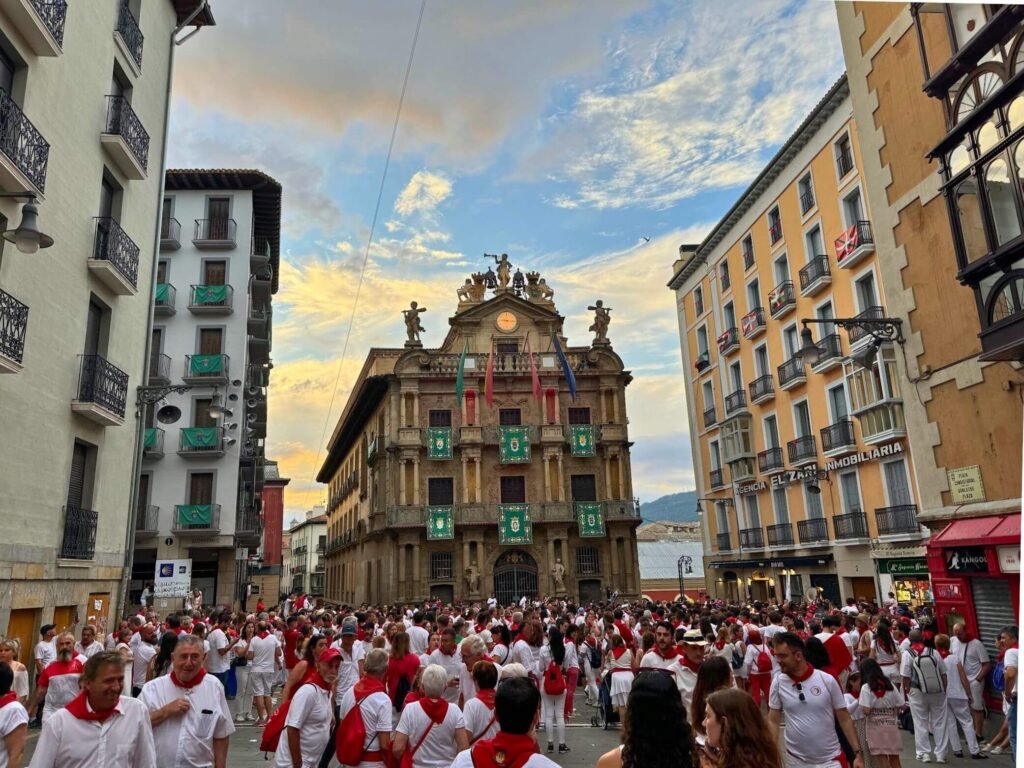
Most people arrive thinking they’re coming for one event. The Running of the Bulls is the thing that gets covered, the thing that fills the highlight reels. But the festival runs nine days, and the bull run happens once each morning in about two to three minutes.
The rest of the time, the city is completely alive in a way that’s hard to explain until you’re standing in the middle of it. San Fermín started as a religious feast honoring Saint Fermín, the patron saint of Pamplona, who was martyred and whose memory the city has celebrated for centuries. Over time, that religious tradition merged with summer livestock fairs and bull-running culture, and the modern festival grew out of all of it.
What surprised me most was how much of the festival had nothing to do with bulls at all. Marching bands, folk performers, fireworks every night, a full fairground, live music stages, spontaneous parades. The run is the headline. The city is the actual event.
Planning your San Fermín trip?
🛌 Book your Pamplona stay early: Booking.com, and Expedia
👓 Book tours: GetYourGuide, and Viator
📱 Set up data in Spain: Airalo
🏥 Travel insurance: IMG for spectators, World Nomads Explorer for U.S. runners
🚘 Rent a car after the event: Discover Cars
Is San Fermín Worth It If You’re Not Running?
Yes, without question.
Like I mentioned before – the run gets most of the attention but the atmosphere, the music, the street life, the fireworks, the random moments of strangers dancing together at midnight — that’s what fills the days and nights.
At San Fermín, there’s live music in the streets at all hours, nightly fireworks, a fairground, traditional performers, parades, and a city that genuinely doesn’t sleep. Families are out during the day. By night it shifts into something rowdier, but even that has a rhythm to it.
If you’re on the fence because you’re not planning to run, go anyway. Spectators have a full experience here, and you don’t need to run or attend a fight to feel like you’re part of something.
How the Running of the Bulls Works
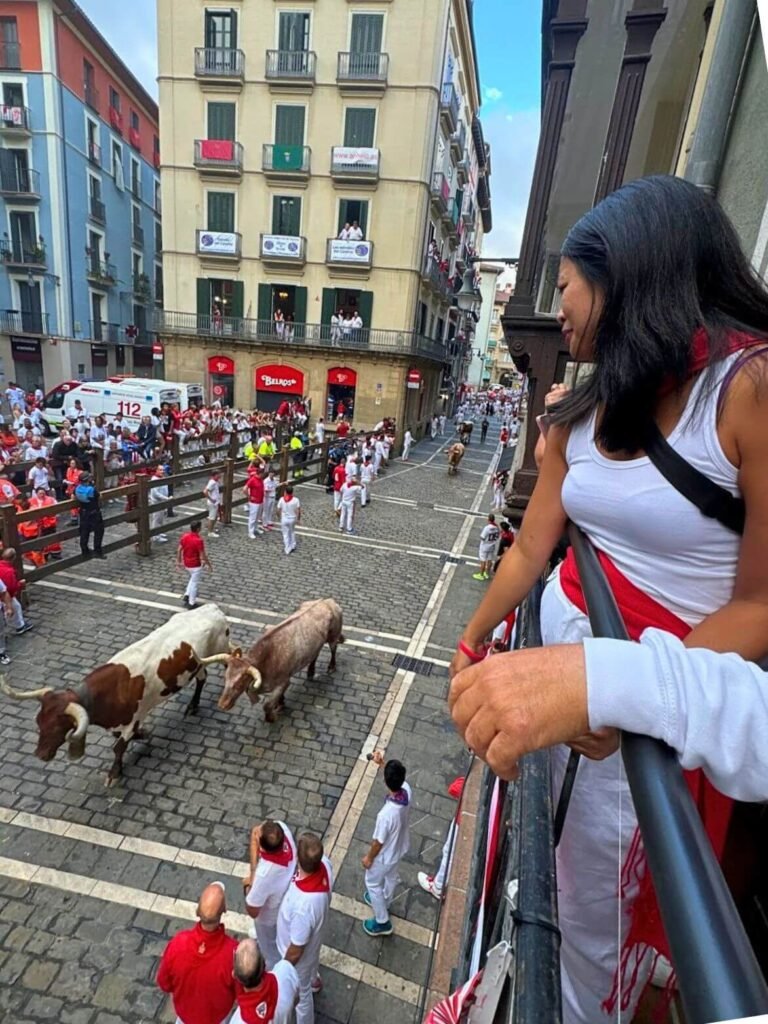
The encierro, or running of the bulls, occurs every morning during the event at exactly 8:00 a.m. The course is 875 meters through Pamplona’s Old Town, starting at the bull pens and ending at the Plaza de Toros bullring. Six fighting bulls run alongside six steers, which are larger, calmer animals that help guide the bulls through the route.
The whole thing is over in roughly two to three minutes.
The thing most people aren’t prepared for is how fast it ends. All of that buildup, all of that tension, and then it’s done before you’ve fully processed what you just saw. That’s part of why your viewing position matters. Two minutes goes differently depending on where you’re standing.
After the run, the bulls fight in the ring that evening. Tickets to the bullfights are sold separately. I didn’t attend and won’t speak to the experience firsthand, but it’s worth knowing the connection exists. The run and the fights are tied to the same tradition. You can choose to engage with one and not the other, but the connection is there.
The Best Ways to Watch the Run
Watching from a Balcony
For first-timers with a budget for it, this is my strongest recommendation.
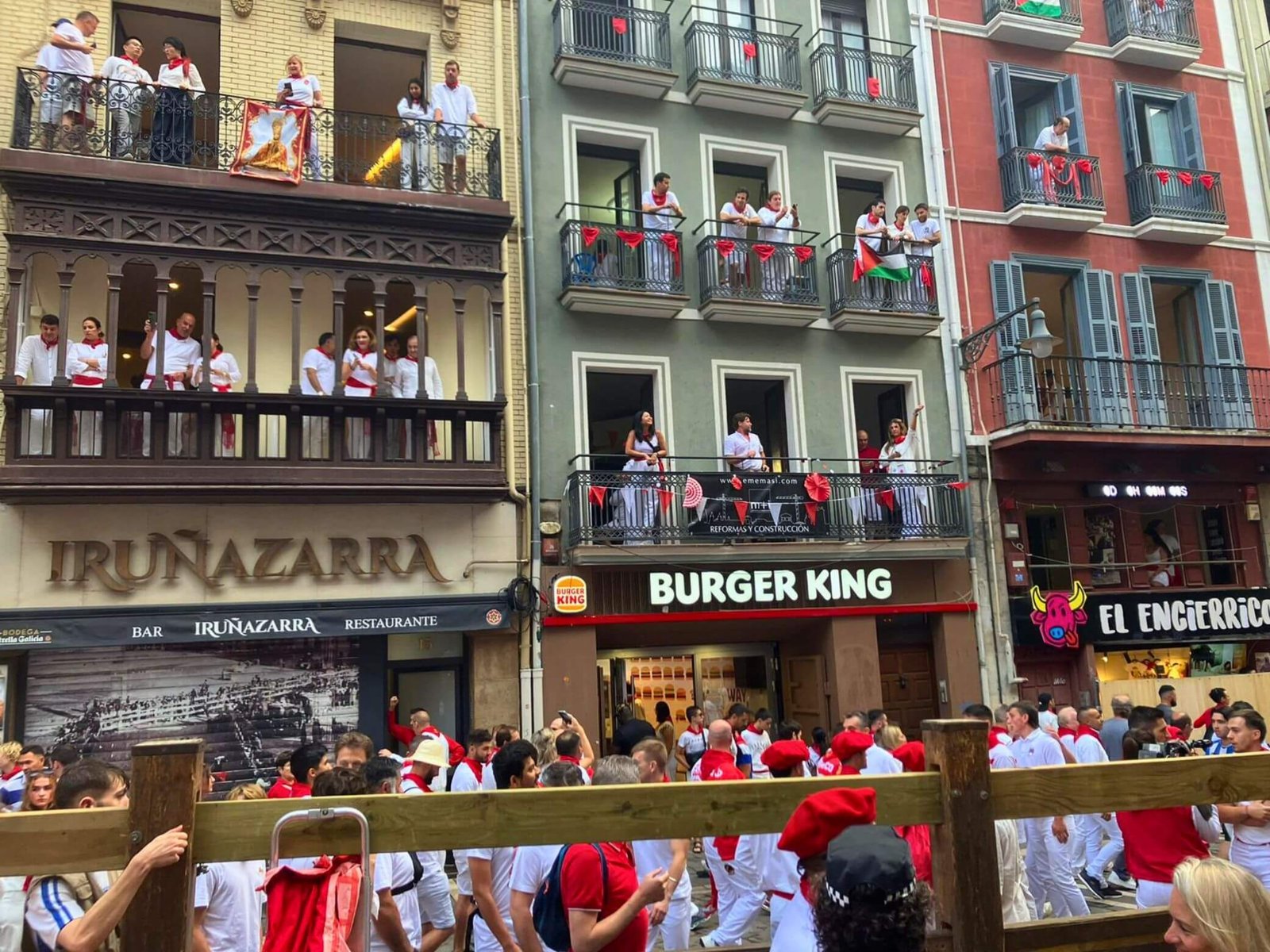
A balcony puts you above the crowd, gives you an unobstructed view of the route, and means you’re not fighting for a sightline at street level with thousands of people around you. Because the run lasts about two minutes, having a clear view of what’s actually happening makes a real difference.
I booked through Destino Navarra and got a spot with a view of Dead Man’s Corner. That’s the most dangerous part of the route, as the 90 degree turn is approached with bulls at full speed, causing bulls to slip and crash into people.
The balcony experience included a local guide who explained the run as it unfolded, coffee and pastries while waiting, a TV replay of the run immediately after, and a view that made the whole route make sense in a way street level never could.
I got a last minute deal and paid €162 at the time of booking. The company’s balconies ranged from €162 -235 depending on location.
Watching from the Street
Street-level viewing is free and completely viable, especially if budget matters more than comfort.
People line up along the barricades that fence off the route and claim spots early. The earlier you get there, the better your sightline. It will be crowded and you may not see much depending on where you end up, but plenty of people watch this way every year and have a great experience.
If you go this route, arrive before 7:00 a.m. and pick your spot deliberately. Straight sections of the course give you a longer window to see what’s happening. The curve at Dead Man’s Corner is more dramatic but the crowd density there is higher.
Balcony vs. Street: What I’d Recommend
If it’s your first time and you can afford it, book the balcony. The run is over in two to three minutes. A better view is not a luxury in the same way it might be for a longer event. It genuinely changes what you experience.
Street-level works and plenty of people prefer it for the ground-level energy. But if you’re traveling specifically for this and want to actually see what’s happening, the balcony is worth the cost.
Book early. I booked a week out and nearly missed my chance.
Where to Stay for San Fermín
If you’re deciding where to stay in Pamplona for Running of the Bulls, the biggest choice is whether to stay in Old Town for convenience and immersion or just outside it for quieter nights and slightly lower prices.

Staying in Old Town
I stayed at Pompaelo Plaza for two nights and paid €992 total. Booking earlier would have been smarter and cheaper, however just note that if you’re staying in premium locations expect premium prices regardless.
The location was ideal. The hotel sits right in the middle of the action, a short walk from Plaza Consistorial and everything else. When you’re out until 2:00 or 3:00 a.m. and then up at 6:30 for the run, being able to walk home matters more than you’d expect.
A few things worth knowing before you book Old Town accommodation:
- It will be loud. The festivities run at all hours and there’s no real buffer if your room faces the street.
- There’s no car access to Old Town during the festival. You’ll walk in from wherever the taxi drops you.
- If this is your first trip and you want the full immersive experience, staying central is worth it. If you’re a light sleeper or trying to keep costs down, staying just outside Old Town may make more sense.
Old Town vs. Staying Farther Out
Old Town is louder, more convenient, and the most expensive. Ensanche and the areas just outside Old Town can give you a little more breathing room while still keeping you close to the festival. For a short trip of two to three nights, I’d stay central. For a longer stay, or if sleep is a real priority, I’d look just outside Old Town instead.
Compare hotels in Pamplona for Running of the Bulls
How Many Nights You Actually Need
Two to three nights is the right answer for most people.
One night feels rushed. You’re getting in, going out, trying to sleep, getting up for the run, and leaving. You don’t get the daytime cultural side of the festival, you don’t have a night to just wander without an agenda, and the whole thing feels like you’re checking a box rather than actually experiencing it.
Three nights gives you a night to arrive and get oriented, a full day and night in the middle, the run, and some recovery time. That’s enough to experience the daytime parades and folk performances, the late-night street music and dancing, the fireworks, and the run itself, without completely destroying yourself.
A full week is a lot. Unless nonstop late nights and very little sleep for seven days sounds genuinely appealing, two to three nights is enough. I’m in my thirties. A few days was exactly right.
What to Wear to San Fermín
The Traditional Outfit
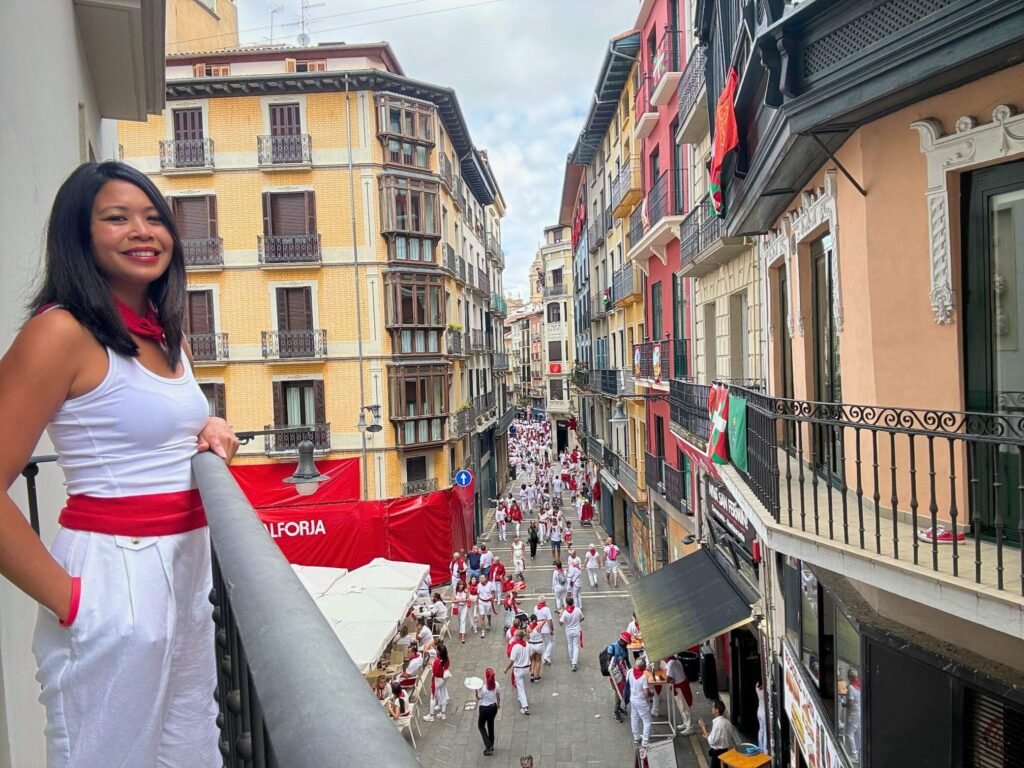
Everyone wears all white with a red scarf and red belt. If you want to feel part of the festival, this is the uniform.
The white represents purity, the red represents Saint Fermín’s martyrdom. The scarf is traditionally tied on after the Chupinazo opening rocket at the beginning of the festival and removed at the closing ceremony.
If you’re staying a few days, bring more than one white shirt. The streets are packed and people are drinking. You will almost certainly get something spilled on you at some point.
What the outfit cost
I bought a scarf and belt at a shop right next to my accommodation when I arrived. Total cost was about €10. Vendors selling the red accessories are everywhere in the city so don’t stress about sourcing them before you go.
Shoes
Wear comfortable closed-toe shoes. This matters especially if you’re running, but it matters for spectators too. You’re walking a lot, the streets get messy, and the festival runs for hours at a stretch. Sandals are a bad idea.
What the Festival Is Like Outside the Run
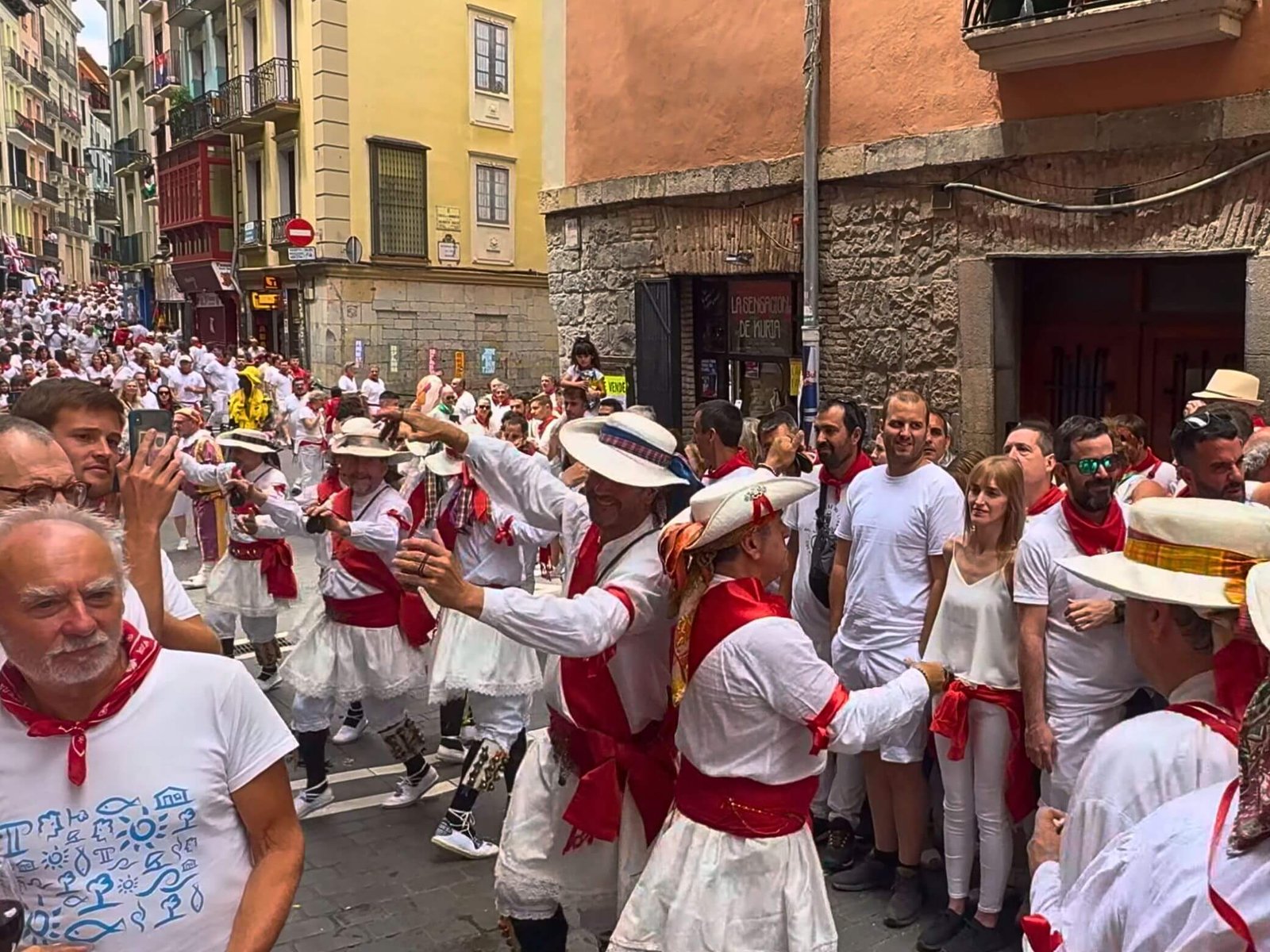
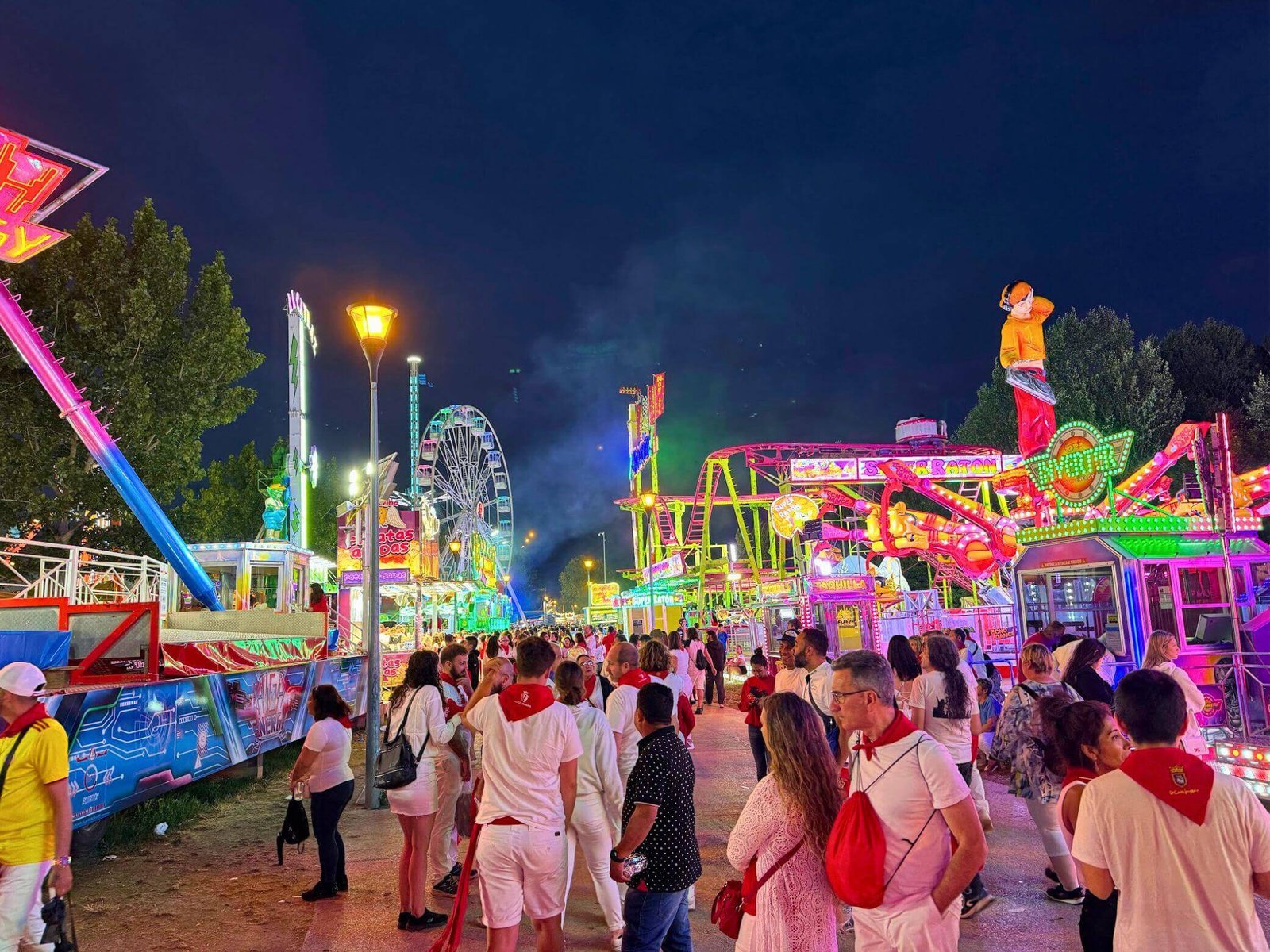
This is the part that most coverage undersells.
The daytime festival feels genuinely family-friendly. Marching bands weave through the streets. Folk performers called Los Danzantes de Pamplona appear in traditional dress with castanets and txistu flutes. There’s a full fairground with carnival rides and games. Families, kids, older locals, everyone is out.
Then every evening during San Fermín there’s a fireworks display. One of the best spots to watch is Vuelta del Castillo park, where you get an open view without buildings interrupting the lower bursts. You can see them from elsewhere in the city but you’ll likely miss part of the show depending on where you’re standing.
At night the energy shifts. The squares fill up, the marching bands give way to bands with mobile amplifiers parading through the streets, people follow them and dance. Live music stages appear around the city. By midnight, Plaza del Castillo is where most people end up, and it functions as a live concert venue for the rest of the night.
The sensory overload is real. Every street has music, every corner has a crowd. Some alleys smell strongly of beer and things you’d rather not identify. It’s chaotic and loud and completely alive in a way that’s hard to describe until you’re inside it.
Rules and Safety
The Basics
Whether you’re running or watching, know these before you go.
Runners must be 18 or older, sober, wearing proper closed-toe shoes, and not carrying phones or cameras during the run. Before the encierro starts each morning, a line of police officers walks the entire route and visually checks the crowd. They will remove anyone who looks drunk, anyone holding a phone up for a selfie, or anyone who doesn’t meet the basic requirements. Don’t test this. Beyond the rules, you’re in a crowd of thousands of people and animals moving fast in a confined space. Use common sense.
If You’re Thinking About Running
I didn’t run, so I won’t coach you through it. What I can tell you from watching is that different sections of the course carry very different levels of risk. Straightaways like Estafeta Street are generally considered more manageable for first-timers. Dead Man’s Corner is where the bulls can pile up and the situation gets unpredictable fast.
Most people don’t run the full 875 meters. Many run for a short stretch and exit through barricades along the route. You’re not required to run the full course and attempting to stay ahead of bulls for the entire distance is not realistic for most people.
If you’re seriously considering running, research it properly before you go. The official site at runningofthebulls.com has route guidance and practical advice. Treat it with the seriousness it deserves.
⛨ Travel insurance for Running of the Bulls
If you’re seriously considering the run, don’t leave insurance as an afterthought. Most standard policies exclude bull running, but World Nomads currently lists it under the Explorer Plan for U.S. travelers. Just confirm that the activity appears in your specific policy before relying on it.
What Running of the Bulls in Pamplona Cost Me
Here’s a rough breakdown of what I spent across three days and two nights. (Note: This was my personal spend for a short, fairly convenience-heavy trip, not the cheapest possible version of San Fermín.)
- Train from Barcelona Sants (round trip): €152.50
- Taxis in Pamplona: approximately €23 total
- Hotel, 2 nights at Pompaelo Plaza: €992
- Balcony viewing through Destino Navarra: €162
- Red scarf and belt: €10
- Food and drinks across the trip: approximately €115
Rough total: approximately €1,454
The hotel is the number that hurts. Booking earlier would have brought that, and my train price, down significantly. Everything else was manageable. The balcony was the best money I spent on the trip.
Practical Tips for First-Timers
These are the things I’d tell a friend going for the first time.
Book accommodation early. Old Town fills up fast and late prices are brutal. The same goes for balcony viewing spots. Both benefit from booking as far in advance as possible, as they do run out.
Travel light if you’re staying in Old Town. The historic center is largely pedestrian during the festival and taxis can only get you so close — you’ll be walking the last stretch to your accommodation regardless.
Don’t underestimate the sleep situation. The festival runs late and the run starts at 8:00 a.m., where you’ll need to arrive early to get a spot. Those two things don’t coexist easily. Build in at least one morning where you’re not expected anywhere.
Two to three nights is enough for most people. You don’t need a week. A few days gives you the run, the nightlife, the daytime culture, and some recovery time without completely wiping yourself out.
Don’t try to optimize every hour. The best parts of San Fermín are the unplanned ones. The band that appears on a balcony above you, the strangers you end up dancing with at midnight, the quiet of the city at 8:15 a.m. after the run is over. Leave room for that.
Final Thoughts
San Fermín is worth going to even if you never run and have no interest in the bullfighting. The festival is much bigger than what gets covered, and the atmosphere of a city that has collectively decided to stop sleeping for nine days is something genuinely hard to find elsewhere.
Plan around the full rhythm of the city, not just the run. The run is two minutes. The city is the experience.
Want to see what the full experience looked like?
I filmed my trip to Pamplona, from arriving in the city to the music, crowds, and watching the run.
San Fermín FAQ-s
READ MORE ABOUT SAN FERMÍN
Looking for more information about attending San Fermín? Here’s some further reading that may be helpful for your trip:
💃🏻 For the full story of what San Fermín felt like — the atmosphere, the music, the moment the bulls came through… read: What Nobody Tells You About San Fermín: My Experience in Pamplona.
🏨 Looking for the best spots to stay based on area? Check out Where to Stay in Pamplona for Running of the Bulls.
▶️ Want to see what San Fermín is like? Check out my Youtube video: Beyond the Bull Run.

I’m Marie, a slowmad and adventurer who left settled life in the U.S. to explore the world more deeply.
I’ve spent about five months in Spain across three stays, mostly in Barcelona, and share what I’ve learned firsthand — from the experiences and adventures worth seeking out to local culture and the little things you notice when you stay a bit longer.
MORE SPAIN
-
Where to Stay in Barcelona: Best Neighborhoods for Your Trip
After spending about five months living in Barcelona across multiple stays, I’ve seen how much the neighborhood you choose can shape your trip. This guide compares the best areas to…
-
Is Barcelona Safe? My Experience Living There Solo
I’ve spent months living in Barcelona, regularly navigating the city alone and coming home late at night. Here’s how safe Barcelona actually feels to me, where I’m more cautious, and…
-
Top 10 Things to Do in Barcelona That Are Actually Worth It
Barcelona has plenty of famous sights worth seeing, but some of the best experiences go beyond the usual checklist. These are the 10 things I’d actually make time for, from…
-
Is Barcelona Worth Visiting? My Honest Take After Living There
Barcelona is one of my favorite cities in Europe, but it isn’t for everyone. After living there for months, here’s my honest take on what makes Barcelona worth visiting, what…