MOVING ABROAD
SHARE:
This post contains affiliate links. If you book through them, I earn a commission at no cost to you. Learn more
Living abroad full time sounds freeing until you realize how much of your life is still tied to a U.S. phone number. Your bank needs to text you a verification code. Your apps want to confirm it’s really you. And then there’s the random Tuesday your card gets frozen abroad and you end up on the phone with your bank for hours.
That’s not the moment you want to be figuring out your phone setup. I learned pretty quickly that I had two separate problems, and I was making it harder by trying to solve both with one phone plan.
The first problem: I needed to keep my U.S. number alive. Not because I’m attached to it, but because my actual life still runs through it. The second: I needed data that worked across countries without quietly draining my budget every month.
If you’re wondering whether Google Fi works for digital nomads, my honest answer is: yes, but mostly as the part that keeps your U.S. number alive, not as the only data plan I’d rely on abroad.
Most U.S. phone plans are built for people who live in the U.S. and occasionally travel. I needed the opposite — something that worked for actually living abroad, moving between countries, and still having a functioning adult life in the background.
So I stopped looking for one perfect international plan and built a setup around what I actually needed. Two years and several countries later, it’s still what makes the most sense for me.
The Two Problems Most People Try to Solve With One Plan
This is the mindset shift that changed everything for me.
If you’re living abroad long term, you’re not just a tourist with a roaming problem. You need your U.S. number to keep working — for 2FA, banking apps, account recovery, work logins, and all the other random parts of adult life — while also needing affordable, reliable data in the country you’re actually living in.
Those are different problems.
Trying to solve both with one regular U.S. carrier usually means overpaying, making things harder than they need to be, or eventually running into limitations.
Once I separated those two needs, the solution became a lot more obvious.
My Current Setup: Google Fi + Airalo
My setup is simple. I use Google Fi to keep my U.S. number active — for texts, verification codes, calls when I need them, and backup data in a pinch. Then I use Airalo for most of my day-to-day data abroad. And for real communication like talking to friends, family, and people I actually know, I mostly use WhatsApp, Facebook Messenger, or Wi-Fi calling anyway.
That’s really it. Google Fi handles the U.S.-number problem. Airalo handles the daily-data problem. That distinction is the whole reason this setup works for me.
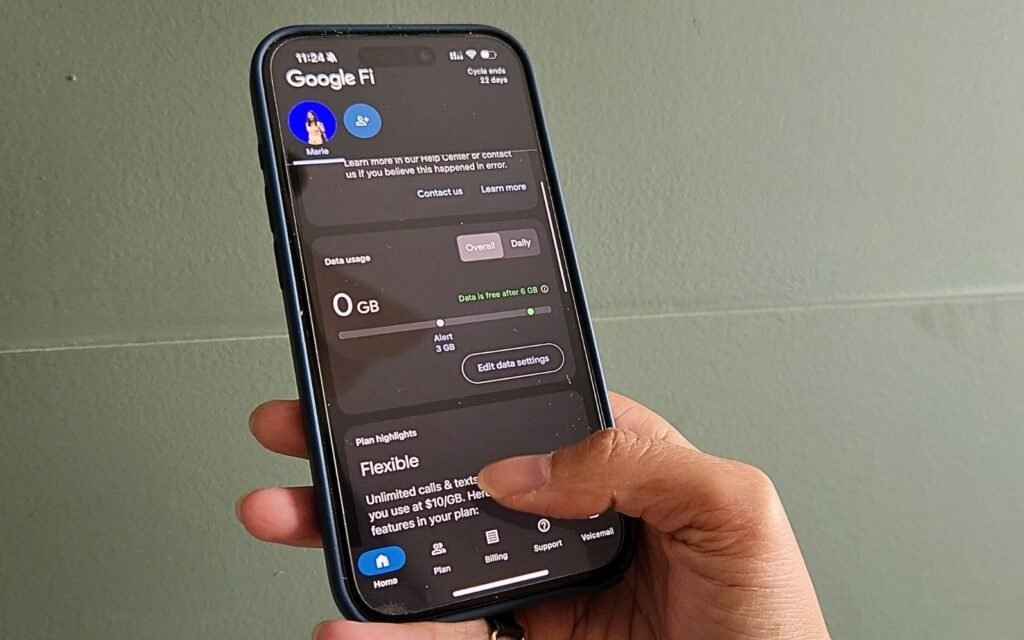
Why Google Fi Works for Keeping My U.S. Number Abroad
When I was researching options before leaving the U.S., Google Fi stood out for a few reasons.
I started with the Flexible plan — $20 base plus taxes, then $10 per GB of data used. Because I knew I’d be pairing it with separate (and cheaper) eSIMs abroad, I didn’t need much Fi data. For example, an Airalo Portugal eSIM could get me 10GB for 30 days for about $11, which made it easier to keep Fi for the number and using something else for data.
What Google Fi actually does for me day to day is pretty simple:
- Receiving texts and 2FA codes — honestly, this is the main reason I keep it
- Emergency calls — especially when I need to deal with a bank, airline, insurance company, or some random admin issue from abroad
- Backup data — useful when I’ve just landed somewhere new, my eSIM isn’t fully set up yet, or I’m in a more remote area
That alone makes it worth it for me.
One thing worth knowing before you commit: Google Fi can pause your international data if you use it abroad for an extended time — roughly 50 days or so. That doesn’t mean your whole phone stops working. For me, the number still works, which means I can still receive texts and verification codes, its only the data that is paused.
Since I’m not relying on Fi as my main data source in the first place, that limitation hasn’t been a dealbreaker. But if you’re planning to use it as your only long-term data plan abroad, that’s a real issue.
So if you’re searching for “Google Fi for digital nomads,” my honest take is that it can absolutely be useful — but mostly as the stable U.S. line in the background, not the whole solution.
👉🏽If Google Fi sounds like it might fit your setup, I’ll leave my referral link here.
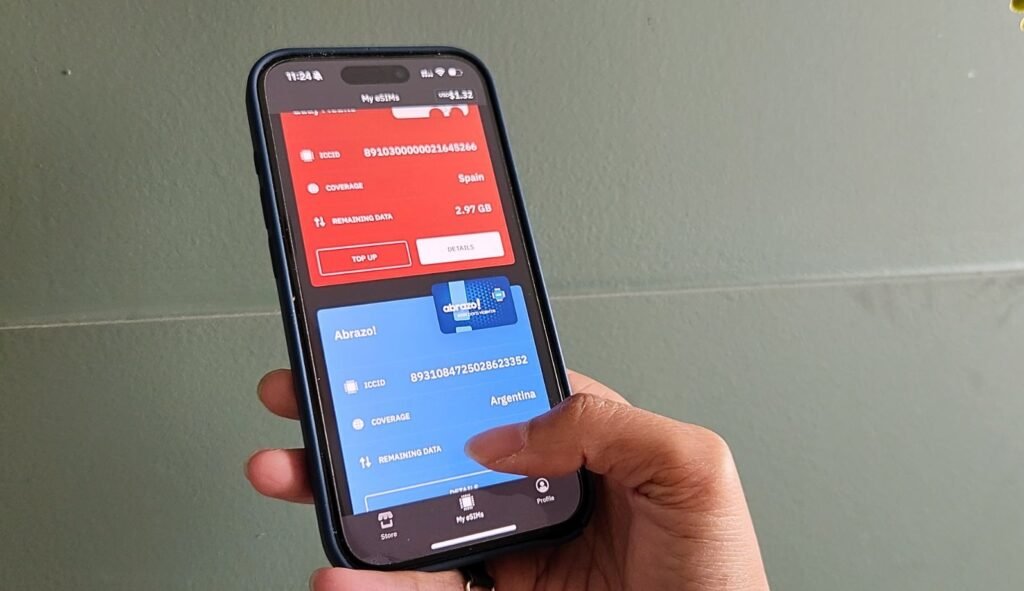
Why I Use Airalo for Data Abroad
Once I understood that Google Fi was really just the part keeping my U.S. number alive, I needed a separate solution for actual data — something that worked across countries without requiring me to find a local phone shop every time I crossed a border.
That’s where Airalo came in.
It’s what I use when I need data in a new country without adding another errand to my arrival day. I can buy a plan from the app, install it in a few minutes, and get connected without hunting down a store the second I land.
For the way I travel — usually staying somewhere for a couple of months, then moving on — it hits a good balance between convenience and cost.
It’s not always the cheapest option, but the flexibility and consistency are worth it to me.
I’ve also tried “cheaper” third-party eSIMs, and a couple of times the data just… stopped working randomly for an hour or two. Not ideal when you’re navigating somewhere new. I haven’t had that issue with Airalo, so its my go-to.
👉🏽 If you want to check Airalo for wherever you’re headed next, I’ll link it here.
When a Local SIM Makes More Sense
I want to be honest about this too, because a lot of posts gloss over it. If you’re staying in one country for several months, a local SIM will often be cheaper than an eSIM.
The tradeoff is that you have to find a store, deal with setup, and sometimes navigate a language barrier or a more annoying registration process.
If I were staying put longer and optimizing mostly for cost, I’d seriously consider going local.
For me, eSIMs make more sense when I want convenience and I’m moving between countries more often.
What Makes Sense Depending on How You Travel
This is how I’d think about it.
If you’re a long-term U.S.-based nomad or slowmad: Keep a U.S. line for your number, and use an eSIM or local SIM for data. That separation is what made the biggest difference for me.
If you’re taking a shorter trip: Your existing carrier’s international pass might honestly be the easiest option, even if it’s not the cheapest.
If keeping your U.S. number is the priority: Don’t try to solve that with a data-only option. You need a real U.S. line.
If cheap data is the main goal: A local SIM in the country you’re staying in will usually beat everything else on price.
If you want the simplest setup: An eSIM like Airalo is hard to beat when you just want to land and get connected quickly.
Before You Leave the U.S., Don’t Skip This
This is the part people forget until it becomes a problem. Before leaving the U.S., I’d make sure:
- your phone is unlocked
- your phone supports eSIM
- Wi-Fi calling is turned on
- your bank texts and verification codes work the way you expect
- you’ve thought through what happens if you lose account access abroad
It’s boring admin, but it’s the kind that makes life abroad feel a lot more sustainable.
My Honest Take on Google Fi for Digital Nomads
If you’re looking into Google Fi as a digital nomad, the most important thing is understanding what problem you want it to solve.
For me, Google Fi solved the U.S.-number problem.
Airalo solved the daily-data problem.
That’s why this setup has worked so well for me. And it’s also why I don’t think Google Fi for digital nomads makes the most sense as a standalone answer. For me, it works best as part of a broader setup — one that keeps my U.S. number active while giving me a more flexible and affordable way to handle data abroad.
It’s not the cheapest setup in every scenario, and it’s definitely not the most minimalist. But it supports the kind of life I’m actually trying to live — not just passing through places, but building a real life in them.
That’s what matters to me most.
Ready to Set Up Your Phone for Living Abroad?
Here are the tools I personally use and recommend:
📱 Google Fi — Keep your U.S. number active abroad 👉 Sign up here
🌐 Airalo — Affordable eSIM data 👉 Sign up here

I’m Marie, a slowmad and adventurer who left settled life in the U.S. to live abroad and explore the world.
I live in countries for months at a time to understand new cultures and explore deeply, sharing my insights on what it’s like to live abroad and the travel adventures along the way.
Learn more about how to move abroad
-

Best Bank Accounts and Cards for Living Abroad Full Time (My Exact Setup)
Most people don’t think about their financial setup until something goes wrong abroad — a declined card, a surprise fee, a transfer that costs way more than it should. Here’s…
-
Google Fi for Digital Nomads: What’s Worked for Me Living Abroad Full Time
Living abroad full time sounds freeing until you realize how much of your life is still tied to a U.S. phone number. Here’s the setup I use to keep mine…
-

How I Choose the Right Neighborhood Abroad
MOVING ABROAD How I Choose the Right Neighborhood Abroad What I look for in a neighborhood when I’m moving to a new city, from energy and livability to social life,…
-

How I Find Apartments Abroad for a 1–6 Month Stay
MOVING ABROAD How I Find Apartments Abroad for a 1–6 Month Stay What I look for in a place abroad, from neighborhood fit to walkability, wifi, and the details that…